


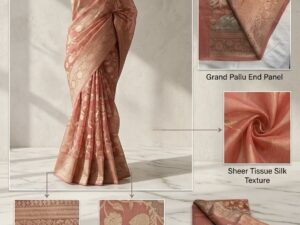
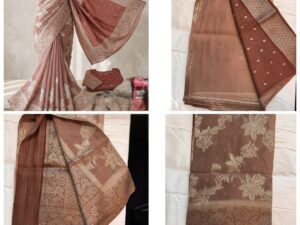
A Katan Alver Jall (more commonly referred to as Allover Jaal) pure handloom saree with Antique Zari represents the pinnacle of Banarasi weaving. It combines a durable, high-luster silk base with an incredibly dense and labor-intensive pattern.
Here is the breakdown of what these terms mean for the quality and look of the saree:
1. The Fabric: Pure Katan Silk
Katan is considered the “gold standard” for Banarasi sarees.
• The Build: It is made by twisting together multiple filaments of pure silk to create a thread that is exceptionally strong, smooth, and lustrous.
• The Feel: Unlike softer silks (like chiffon or georgette), Katan has a structured body. It creates a sharp, regal silhouette and holds pleats perfectly, which is why it is the preferred choice for bridal and heirloom pieces.
2. The Pattern: “Alver Jall” (All-over Jaal)
The term Jaal (meaning “net”) refers to a continuous, interlocking pattern of floral vines, creepers, or geometric motifs that covers the entire body of the saree.
• Coverage: “Alver” is a common phonetic spelling for All-over. This means the design doesn’t just appear in patches (butis) but flows across the entire fabric, leaving very little plain space.
• Technique: In a pure handloom piece, this is usually achieved using the Kadhwa technique, where each motif is woven individually on the loom. This prevents loose threads on the back and makes the design appear “embossed” on the silk.
3. The Finish: Antique Zari
Traditional zari can sometimes be very bright or “yellow,” but Antique Zari offers a more understated, “old-money” aesthetic.
• Visuals: It has a muted, dull-gold or bronzed finish that mimics the look of vintage heirlooms. It is less “shiny” than regular gold zari, giving it a sophisticated, matte-like glow.
• Feel: Because it is designed for high-end handlooms, antique zari is typically softer and more flexible, ensuring the saree remains drape-friendly despite the heavy metal work.
4. Why it is a “Collector’s Piece”
• Weight & Grandeur: Because of the density of the “Jaal” work and the thickness of Katan silk, these sarees are generally heavier than others. They carry a physical weight that feels substantial and royal.
• Time Intensive: A single Katan Allover Jaal saree can take anywhere from 3 weeks to 3 months to weave by hand, depending on the complexity of the jaal.
• Investment: These are considered investment pieces. Due to the purity of the silk and the quality of the zari, they do not lose their luster over time and are often passed down as family heirlooms.
Reviews
There are no reviews yet.